Abstract
We present StarCore, a next-generation world model designed to transition the paradigm of world models to the cybersecurity world. Building upon the capabilities of learning multimedia data in the system world, including code, commands, traffic, and agent traces, StarCore adopts the technique of system state chain learning to significantly improve the performance of understanding and analyzing the dynamic data streams behind diverse network systems. To advance the model in the dynamic system world, we implement a new state-chain learning framework for system data that models the system world's states with diverse benign and malicious behaviors and introduces three state-chain supervised fine-tuning tasks for system world understanding. Furthermore, we propose a novel RL framework based on GRPO algorithms with state-chain rewards that further improve the quality of understanding system state chains and reasoning for security analysis. Through these innovations, StarCore achieves state-of-the-art performance on state chain completion, prediction, and security analysis tasks. Most critically, StarCore demonstrates unprecedented capability in understanding dynamic real-world system information streams, surpassing traditional foundation models that rely on simple QA reasoning for cybersecurity. Code, models, and more information are available at github.com/metaordo/StarCore.
网络空间已经从一个传统的信息交换环境,演化为由软件代码、操作系统、网络协议、业务应用与自主智能体共同构成的复杂动态系统世界。攻击行为也不再局限于单一漏洞利用或固定攻击模式,而是围绕目标系统的运行状态持续展开的多阶段行动。主流防御技术依赖人工规则、签名匹配与在单一时间点分析单一数据类型的机器学习分类器——它们把每种数据模态视为孤岛,产出的是静态实体关系快照,而非系统状态如何随时间转移的模型。
1. Introduction
大语言模型已经开始重塑安全运营:Microsoft Security Copilot 把 LLM 与安全数据源、工具调用编排结合起来做告警分析与威胁解释;Cisco 在 CVE、CWE、ATT&CK 与威胁情报语料上持续预训练 Llama-3.1 基座,得到安全知识推理模型。它们具备强大的知识理解与文本推理能力,却是在静态文本上训练的,其知识表示由文档间的语义关系主导。它们知道安全,却不理解系统世界。
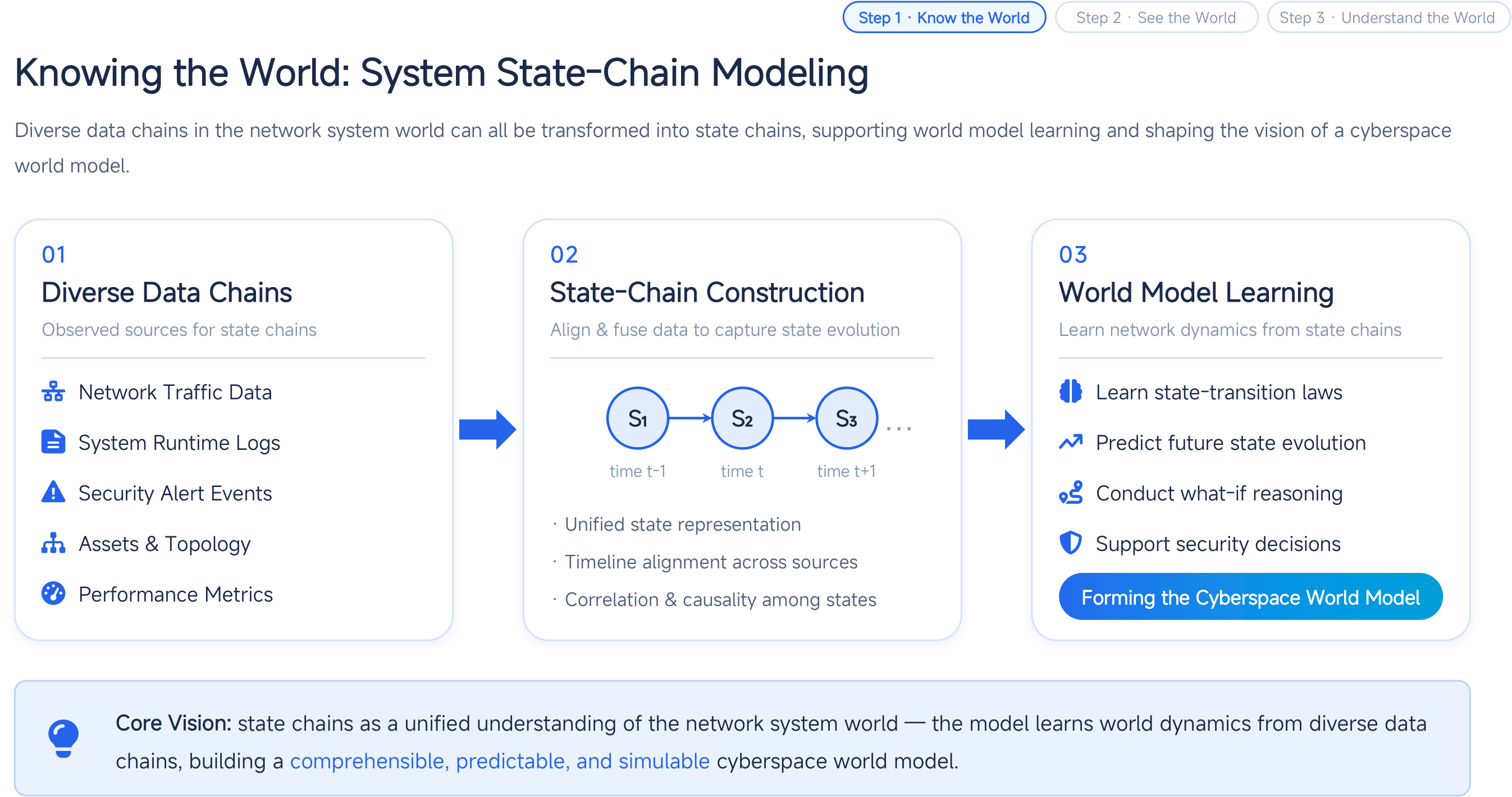
StarCore 把网络系统世界中的系统数据流作为待理解的最小世界集合:执行代码、系统命令、网络流量与智能体交互轨迹等异构数据被视为世界状态的描述。在每个模态内,连续状态沿系统执行顺序串联为执行状态链,形成大规模长距离有向链,在结构上表示系统运行世界,并捕获系统状态演化中的攻击传播。
Technical Contributions
- 系统世界的状态链建模方法。在代码、流量、命令与智能体轨迹上定义多模态统一状态空间,将静态、孤立的事件记录转化为连贯、按时间排序的行为叙事。
- 状态链监督的世界理解学习范式。不学习安全知识之上的问答映射,而是以补全、预测、安全研判三类任务直接监督状态链,内化网络系统状态的演化规律、因果机制与跨模态关联。
- 状态链强化学习对齐方法。利用多维状态链奖励(SCR)评估不同模态的状态链理解能力,并用 GRPO 探索多样推理路径与运行系统的多种可能状态。
2. System State-Chain Modeling
2.1 A Unified State Space for the System World
系统世界由不同系统数据流——执行代码、网络流量、系统命令——以及运行其上的智能体交互轨迹共同构成。给定代表 t 时刻系统当前状态的数据 oₜ,它来自上一时刻 oₜ₋₁ 与良性或恶意系统行动 aₜ₋₁(aₜ ∈ A),世界模型 GWM(oₜ, aₜ) 应建模完整的系统转移轨迹:
2.2 Uni-modal System State Chain
在单一模态内,行为连续、按时间有序、受演化规律支配,因此沿时间轴拼接连续状态:
- Code Execution Chain. 追踪程序运行的指令执行轨迹,沿控制流拼接基本块或代码行状态。
- Network Traffic Chain. 围绕会话或相关流,按时间拼接包/流状态,刻画握手、传输到断开的完整通信序列。
- System Command Chain. 在用户会话或服务进程生命周期内按时间戳拼接命令或审计事件状态。
- Agent Interaction Chain. 在一个智能体任务会话内拼接对话轮次或工具调用步骤状态。
2.3 Multi-modal System State Chain
当攻击跨多模态链执行时,复杂交互无法被统计学 QA 与传统 LLM 的有限窗口捕获。一次远程 shell 攻击会同时触发系统命令链与网络流量链。建模大规模多模态状态链时,等价的行动会在不同数据链中产生交叉点——公共状态,连接两条或多条链,形成网络空间的交互图。
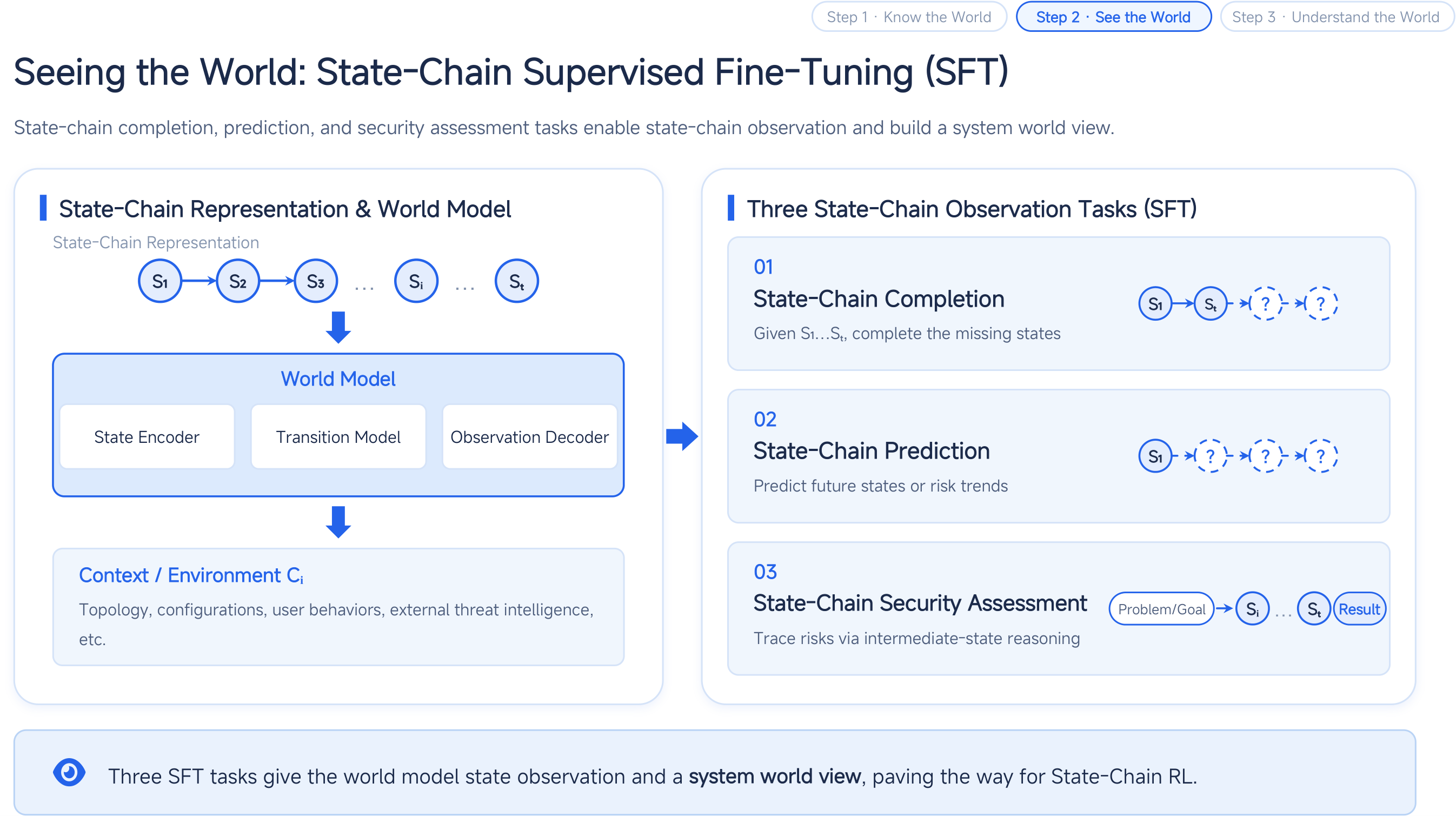
3. State-Chain Supervised Fine-Tuning
SFT 阶段把传统 LLM 转化为具备网络空间数据链推理能力的世界模型。以系统状态链而非知识问答对作为监督目标,StarCore 的 SFT 数据覆盖五类:Instruction、Question、States、Action Reasoning、Answer。以 Qwen3.5-9B 为基座,学习 GLM-5.2、MiniMax M3、DeepSeek-V4-Pro、Kimi K3 的推理结果作为行动推理参考。
3.3 State Chain Completion
真实系统中观测常因丢包、日志不足或可见性受限而不完整。补全任务要求模型从前后状态推断未观测状态,而不只是记忆单个观测,学习推断不完整观测背后的潜在系统活动。
3.4 State Chain Prediction
预测关注尚未观测的未来状态,每个预测状态以历史观测与先前预测状态为条件,捕获运行系统的时间演化模式。
3.5 State Chain Security Assessment
要求模型分析完整状态链并考察中间状态关系:恶意活动可能在单步伪装为合法操作,只有通过累积证据与多状态交互才显现意图。通过联合学习中间行动推理 R 与最终研判 Y,支持攻击溯源、意图识别与基于证据的风险评估。
4. State-Chain Reinforcement Learning
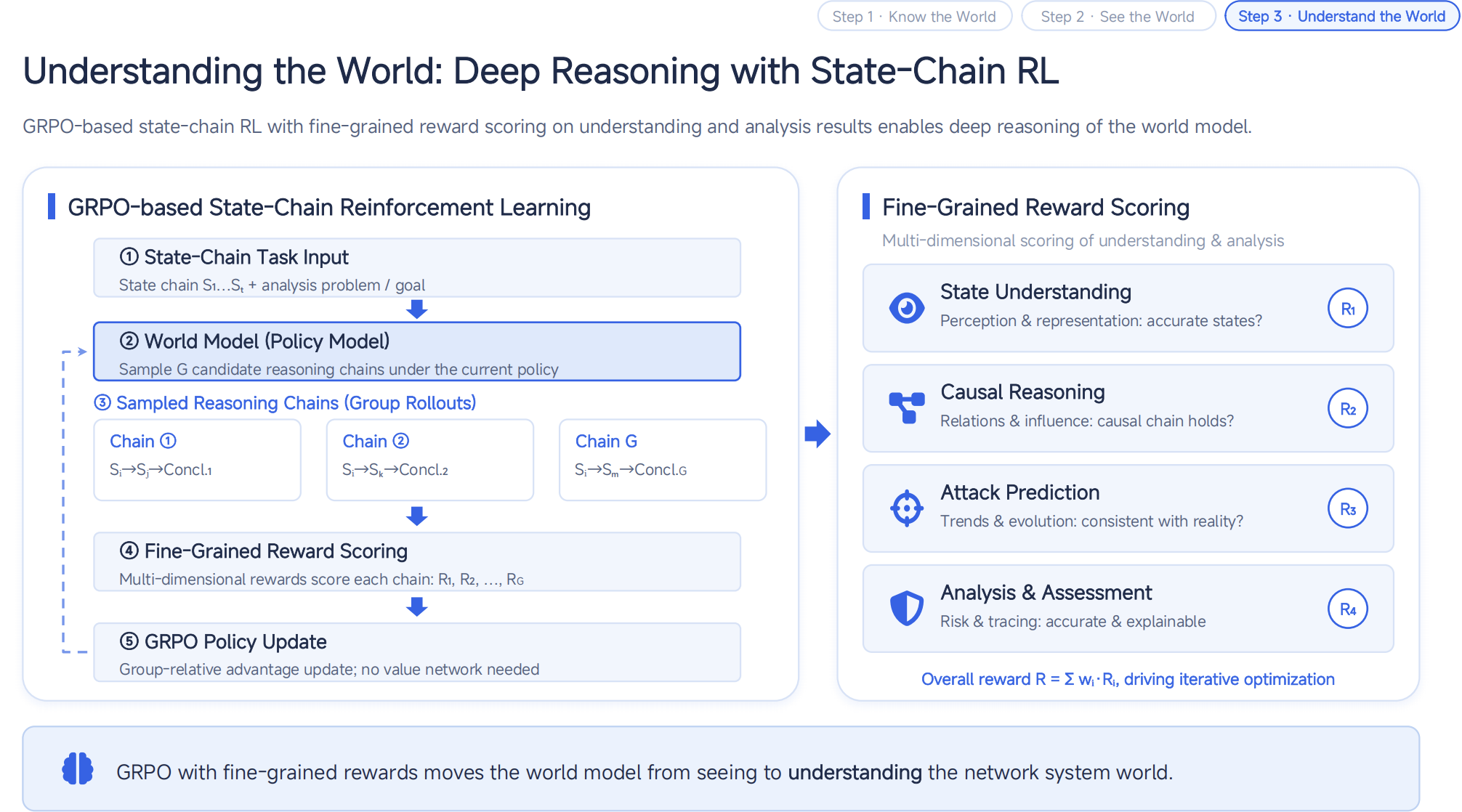
监督学习主要优化预定义参考轨迹的似然,可能限制模型探索多样推理路径。我们引入基于 GRPO 的状态链强化学习,以多维状态链奖励 SCR 直接评估状态链理解与行为推理质量。
SCR 从五个互补维度评分:输出格式 rfmt、状态理解 rstate、因果推理 rcausal、攻击预测 rpred 与安全研判 rassess,按任务类型 τ 激活并归一化权重。GRPO 对同一输入采样 G 条轨迹,用组内相对优势 Âi = (ri − μr) / (σr + ε) 更新策略,并以 KL 约束保持与 SFT 参考策略的偏离——无需额外价值网络。
5. Evaluation
我们在 NVIDIA B300 与 A800 上开发与评测。语料覆盖四大模态:源代码、网络流量、操作系统日志与智能体轨迹,来源包括 Hugging Face、GitHub、ModelScope 等开源平台。评测覆盖四种数据模态与三类系统世界理解任务。
Overall Answer Accuracy
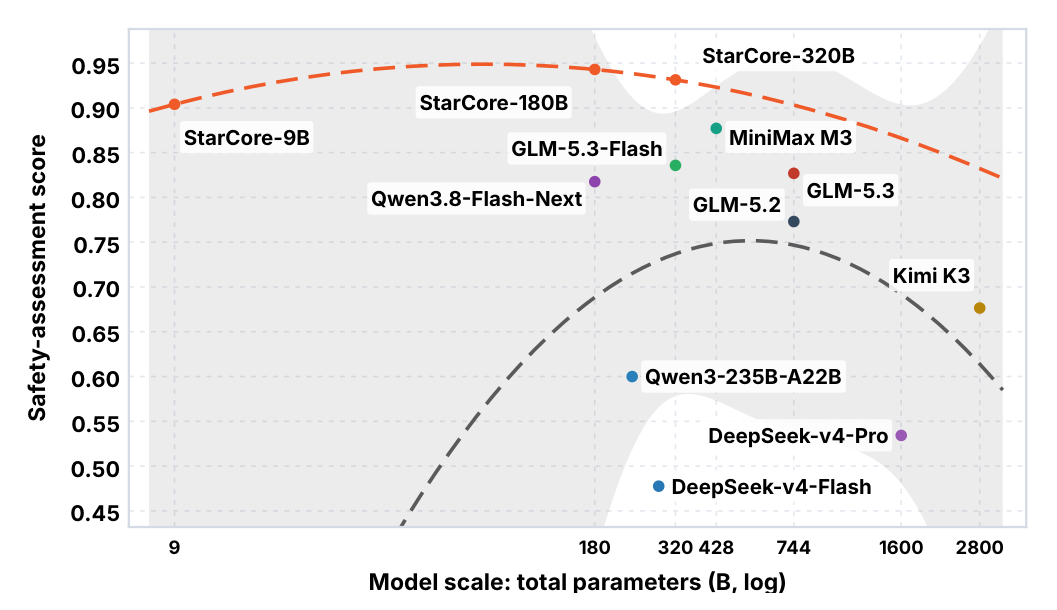
StarCore-180B 取得最高的综合准确率 0.9238,比最强基线 Qwen3.5-35B(0.7561)高出 16.77%,提升横跨全部七个评测维度。四类系统数据模态上分别达到 0.9306、0.9603、0.9672 与 0.8371,较各类最强基线提升 13.75%、13.24%、17.41% 与 17.02%;三项系统世界理解任务上达到 0.9429、0.9301 与 0.8983,其中状态补全与状态预测较各自最强基线提升 25.87% 与 21.05%。StarCore-9B 以 0.8201 超越 Qwen3.5-9B(0.7328)8.73%;320B 变体综合 0.8802,低于 180B,说明单纯增大模型规模并不必然带来更高准确率。
Reasoning Capability
StarCore-9B 取得最高的综合推理正确率 52.8,领先第二名 MiniMax M3(47.7)5.1%,并在安全研判、状态补全、代码理解、智能体轨迹与网络流量理解五个维度最佳。它在状态预测与系统命令理解上并非第一,但整体最均衡。
Code Security Case Study
探索性研究基于 83 个带参考答案的代码样本,以固定哈希规则确定性地抽取 50 个(13 个参考阳性、37 个参考阴性),在两种条件下评测:仅二分类判定,以及额外要求漏洞机理、代码证据、假设与限制的证据解释。二分类条件下,StarCore-320B 表现最强:检出 13 个参考阳性中的 11 个、仅 1 个参考误报,精确率 91.67%、召回率 84.62%、F1 88.00%(响应可用性 94%);StarCore-180B 工作点更保守(精确率 88.89%、召回率 61.54%)。作为对照,Gemini 3.1 Pro 虽同样检出 11 个参考阳性,但产生 18 个参考误报、精确率仅 37.93%;Opus 5.5 为 66.67% 精确率 / 76.92% 召回率;GPT-6.1-sol 精确率 41.18%。需要强调:这些指标衡量的是与所提供参考标签的一致性,而非在独立漏洞真值上的验证性能。
| Model | Overall | Security | Completion | Prediction |
|---|---|---|---|---|
| Qwen3.5-9B | 0.7328 | 0.8845 | 0.6426 | 0.6596 |
| Qwen3.5-35B | 0.7561 | 0.9012 | 0.6709 | 0.6878 |
| MiniMax M3 | 0.7134 | 0.8771 | 0.6201 | 0.6584 |
| DeepSeek-v4-Pro | 0.5563 | 0.5343 | 0.5398 | 0.5946 |
| Kimi K3 | 0.5902 | 0.6765 | 0.5632 | 0.5170 |
| StarCore-9B | 0.8201 | 0.9040 | 0.8380 | 0.7207 |
| StarCore-35B | 0.8872 | 0.8716 | 0.9122 | 0.8781 |
| StarCore-180B | 0.9238 | 0.9429 | 0.9301 | 0.8983 |
| StarCore-320B | 0.8802 | 0.9313 | 0.9237 | 0.7851 |
7. Conclusion
StarCore 引入统一的系统状态链表示,捕获代码执行、网络流量、系统命令与智能体交互等异构数据间的时间与行为关系,并结合状态链监督微调与基于 GRPO 的强化学习。StarCore-180B 取得 0.9238 的综合准确率,领先最强基线 16.77 个百分点;紧凑的 StarCore-9B 取得最高推理正确率 52.8,并在安全研判上超越更大的模型。
References
- Anthropic. Claude Opus 5.5 — official model release, September 2026. anthropic.com/claude-opus-5-5
- D. Barradas, N. Santos, L. Rodrigues, S. Signorello, F. M. V. Ramos, and A. Madeira. FlowLens: Enabling Efficient Flow Classification for ML-based Network Security Applications. In NDSS, The Internet Society, 2021.
- Y. Bengio, R. Ducharme, P. Vincent, and C. Jauvin. A Neural Probabilistic Language Model. Journal of Machine Learning Research, 3:1137–1155, 2003.
- BigModelGym. Cyberspace World Model Benchmark · Security Cognition in Cyberspace, 2026. bigmodelgym.com
- Cisco. Cisco AI for Security, 2025. cisco.com/site/us/en/products/security/artificial-intelligence-ai
- DeepSeek-AI. DeepSeek-R1: Incentivizing Reasoning Capability in LLMs via Reinforcement Learning. arXiv:2501.12948, 2025.
- DeepSeek-AI. DeepSeek-V4: Towards Highly Efficient Million-Token Context Intelligence. arXiv:2606.19348, 2026.
- C. Fu, Q. Li, and K. Xu. Detecting Unknown Encrypted Malicious Traffic in Real Time via Flow Interaction Graph Analysis. In NDSS, The Internet Society, 2023.
- Google DeepMind. Gemini 3.1 Pro Model Card — published February 2026. deepmind.google/models/model-cards/gemini-3-1-pro
- D. Ha and J. Schmidhuber. World Models. arXiv:1803.10122, 2018.
- D. Hafner, J. Pasukonis, J. Ba, and T. Lillicrap. Mastering Diverse Control Tasks through World Models. Nature, 640:647–653, 2025.
- A. Q. Jiang, A. Sablayrolles, A. Roux, A. Mensch, B. Savary, C. Bamford, D. S. Chaplot, D. de Las Casas, E. B. Hanna, F. Bressand, et al. Mixtral of Experts. arXiv:2401.04088, 2024.
- Kimi. Kimi API Platform, 2025. platform.kimi.com
- Y. LeCun. A Path Towards Autonomous Machine Intelligence. OpenReview, 2022.
- Microsoft. Cloud Security Solutions, 2025. microsoft.com/en-us/security
- S. M. Milajerdi, R. Gjomemo, B. Eshete, R. Sekar, and V. N. Venkatakrishnan. HOLMES: Real-time APT Detection through Correlation of Suspicious Information Flows. In 2019 IEEE Symposium on Security and Privacy (SP), pages 1137–1152, 2019.
- MiniMax. MiniMax M3: Frontier Coding, 1M Context, Native Multimodality — All in One Model — official model release, June 2026. minimax.io/blog/minimax-m3
- Mordor Intelligence. Network Security Market Size & Share Analysis, 2025. mordorintelligence.com/industry-reports/network-security-market
- OpenAI. GPT-6.1 Sol — official model release, 2026. openai.com/index/introducing-gpt-6-1-sol
- Z. Shao, P. Wang, Q. Zhu, R. Xu, J. Song, X. Bi, H. Zhang, M. Zhang, Y. Li, Y. Wu, et al. DeepSeekMath: Pushing the Limits of Mathematical Reasoning in Open Language Models. arXiv:2402.03300, 2024.
- G. Team. GLM-5: From Vibe Coding to Agentic Engineering. arXiv:2602.15763, 2026.
- M. A. Team. Llama 3, 2025. llama.com/models/llama-3
- Q. Team. Qwen3 Technical Report. arXiv:2505.09388, 2025.
- M. Zhang, G. Li, S. Wang, C. Liu, A. Chen, H. Hu, G. Gu, Q. Li, M. Xu, and J. Wu. Poseidon: Mitigating Volumetric DDoS Attacks with Programmable Switches. In NDSS, The Internet Society, 2020.